Q: How do I know if my prop is sized correctly?
A: Your prop is sized correctly if
the engine rpm of the boat is redlined at wide open throttle. If the
engine rpms are below redline, decrease the pitch of the prop. If the
engine rpms are above redline, increase the pitch of the prop. (Back To Top)
Q:
How do I determine the diameter of my
propeller?
A: Double the distance between the
center of the hub and the tip of one of the blades. (Back
To Top)
Q:
What is pitch?
A: Pitch is the amount of ‘twist’
in the blades of the propeller. It is defined as the theoretical
distance the propeller will travel forward in one revolution. Thus, in
theory, a 13” pitch propeller will move the boat forward 13” with each
revolution. In actuality, the boat will move forward less than 13” due
to slip. (Back To Top)
Q:
How do I determine the pitch of my propeller?
A: The pitch is usually stamped on
the hub of the propeller. (Back To Top)
Q:
What is slip?
A: Slip is the difference between
theoretical and actual speed expressed as a percentage. A 14” pitch
propeller that moves the boat forward 7” per revolution has 50% slip.
Slip can be used to compare the efficiency of propellers with the same
pitch and diameter. (Back To Top)
Q:
If I increase the pitch of my propeller,
will I go faster?
A: In most cases, no. Increasing
the pitch will only help if your engine rpms currently exceed the
redline at wide open throttle. Otherwise, unless horsepower is
increased, the additional pitch will decrease engine rpm and the boat
will probably go slower. This is also harder on the engine. (Back To Top)
Q:
Can I go faster if I decrease diameter and
increase pitch?
A: Pitch cannot be substituted for
diameter without a loss in efficiency and performance. (Back To Top)
Q:
What is cup?
A: Cup is a small curl placed on
the trailing edge of the propeller blades. Cup reduces cavitation and
slip, typically producing an average increase of 3 mph over uncupped
propellers. (Back To Top)
Q:
What is the difference in performance
between 3-blade and 4-blade propellers?
A: 4-blade propellers have
superior acceleration, improved handling, and better throttle response
than 3-blade propellers. 4-blade propellers also have less vibration
than 3-blade propellers. This makes 4-blade propellers an excellent
choice for 3-event skiing. 3-blade propellers produce higher top
speeds. This makes a 3-blade more suitable for barefoot skiing. Also
3-blade propellers are less expensive than 4-blade propellers. (Back To Top)
Q:
What is Nibral?
A: Nibral is an alloy of nickel,
bronze, and aluminum. It is stronger than bronze, but not as strong as
stainless steel. Most propellers for tournament inboards are made of
nibral. (Back To Top)
Q:
What is the difference between stainless
steel and nibral propellers?
A: Stainless steel is stronger,
more durable, and more expensive than nibral. Stainless steel props
typically have a higher top end than nibral propellers. (Back To Top)
Q:
Aren’t stainless props more likely to damage
my shaft if I hit something?
A: A major propeller strike will
bend the shaft no matter what material the propeller is made of. A
minor strike is more likely to damage a nibral propeller, while leaving
a stainless prop and the underwater gear undamaged. (Back
To Top)
Q:
I ski at a 3000’ lake. Do I need a modified
propeller for this elevation?
A: At 3000’ your engine will
experience an approximate 10% loss in power. The loss in power is even
greater above 3000’. Therefore, a modified propeller is necessary at
elevations of 3000’ and above. Additionally, if your boat is used at
sea level and at elevations of 3000’ or higher you will need two
differently sized propellers to run properly at both locations. (Back To Top)
Q:
How do I remove an inboard propeller?
A: Inboard propellers are removed
with a prop puller. Position and tighten the prop puller until the
propeller comes loose. For propellers that are particularly stubborn,
try tapping the puller bolt in line with the drive shaft with a soft
faced hammer. It is also a good idea to only back off the prop nut two
turns until the propeller has been broken free from the shaft taper.
Finish removing the nut. (Back To Top)
Q:
How do I install an inboard propeller?
A: Seat the propeller on the drive
shaft without a prop key. Mark the location of the propeller on the
drive shaft with a felt-tip pen. Remove the propeller, install the prop
key, and reseat the propeller on the drive shaft. The propeller should
reseat at the mark. If it does not, check the drive shaft for burrs,
reposition the prop key, and try again. (Back
To Top)
Q:
How many ducks are on this page?
A: You didn't think we would make
you try to count this many did you? That would just be mean. There are
32,000 on this page. You probably would have missed a few since some
are hiding behind images. (There are 800 rows with 40 in each row.)(Back To Top)
Typical Propeller Applications
4 Blade
Propellers (Back To Top)
Brendella
1993 & earlier with 1:1 13 x 13 x 1 LH
1993 & later with 1:1 13 x 13 x 1 1/8 LH
Correct Craft
with 1:1 13 x 13 x 1 RH
with 1.23:1 13 x 16 x 1 RH
with 1.46:1 14 x 18 1 1/8 RH
M.B. Sports
with 1:1 13 x 13 x 1 1/8 LH
Malibu
1992 & earlier with 1:1 13 x 13 x 1 LH
1993 & later with 1:1 13 x 13 x 1 1/8 LH
with 320 hp & 1:1 13 x 14 x 1 1/8 LH
with 1.46:1 14 x 18 x 1 1/8 LH
Mastercraft
with 1:1 13 x 13 x 1 LH
with 1.5:1 14 x 18 x 1 1/8 LH
with 454 13 x 14 x 1 LH
Moomba
with 1:1 13 x 13 x 1 LH
Sanger
1996 & earlier 13 x 13 x 1 LH
1997 & later 13 x 13 x 1 1/8 LH
Supra
with 1:1 13 x 13 x 1 LH
3-Blade Propellers
Brendella
1993 & earlier with 1:1 13 x 13 x 1 LH
1993 & later with 1:1 13 x 13 x 1 1/8 LH
Correct Craft
with 1:1 13 x 13 x 1 RH
with 1.23:1 14 x 16 x 1 RH
with 1.46:1 14 x 18 1 1/8 RH
M.B. Sports
with 1:1 13 x 13 x 1 1/8 LH
Malibu
1992 & earlier with 1:1 13 x 13 x 1 LH
1993 & later with 1:1 13 x 13 x 1 1/8 LH
with 1.46:1 14 x 18 x 1 1/8 LH
Mastercraft
with 1:1 13 x 13 x 1 LH
with 1.5:1 14 x 18 x 1 1/8 LH
with 454 14 x 14 x 1 LH
Moomba
with 1:1 13 x 13 x 1 LH
Sanger
1996 & earlier 13 x 13 x 1 LH
1997 & later 13 x 13 x 1 1/8 LH
Supra
with 1:1 13 x 13 x 1 LH (Back To Top)
Vibration
Sources
From time to time
inboard boats develop a problem with vibration. Drive train vibration,
if significant, is very debilitating to the drive train components and
should be eliminated as soon as possible.
There are many causes of
vibration in the drive train. These include a propeller that is
unbalanced or improperly seated, a bent drive shaft, strut, or rudder,
worn strut bearings, engine misalignment, loose engine mounts, or a
combination of the above. Usually, vibration can be considerably
reduced or eliminated by following a systematic checklist to pinpoint
the source(s) of the vibration. This checklist may be similar to the
following:
1. Check drive train for
signs of obvious damage.
2. Check that the propeller is seated properly on the shaft taper.
3. Check for loose engine mounts.
4. Check engine alignment.
5. Try a different propeller.
6. Remove drive shaft and have it checked for straightness and taper
runout.
7. Install new strut bearings.
8. Consider replacing the strut.
9. Seek professional help.(Back To Top)
Shaft Information
There are many decisions
to be made when ordering a replacement drive shaft. The following
information may help you make the right choices for your boat. There
are two basic designs, single-taper drive shafts and double-taper drive
shafts. A.R.E. Manufacturing, Inc. has also developed the patented
System drive shaft, which is the most advanced and innovative
double-taper drive shaft available.
Single-taper shafts are
tapered only on the propeller end. They are press fit into the coupling
and secured with set screws. Since the diameter of shafting can vary by
up to .004”, single-taper shafts and couplings should be replaced as a
factory matched set. This will prevent an improper fit, which may
vibrate loose and cause major damage to the boat. Double-taper shafts
are tapered and threaded on both ends of the shaft. The coupling is
machined with a mating taper. The tapers are seated by tightening a
retaining nut onto the shaft, which produces a secure, vibration-free
joint. Double-taper shafts, when properly machined and installed, run
truer and are much less likely to work loose from the coupling. Also,
double-taper shafts and couplings with the same taper can be sold
seperately without the fit problems of the single-taper design.
Another consideration of
drive shaft design is serviceability. Typically, single-taper shafts
are more difficult to service than double-taper shafts. A.R.E. System
shafts are the easiest to service. Single-taper shafts are pounded out
with a slide hammer or cut in two at the coupling. The slide hammer
method is time-consuming, laborious, and detrimental to transmission
bearings and seals. Cutting the shaft is relatively quick and easy, but
is not an option when the shaft is to be reused. With double-taper
shafts, the coupling is unbolted from the transmission flange and the
retaining nut is removed. A spacer is put on the end of the shaft and
the coupling is rebolted to the transmission flange until the shaft
breaks free from the coupling. This method works well, but is
time-consuming and could bend the transmission flange and cause
alignment problems. To solve these service problems, A.R.E.
Manufacturing, Inc. designed the System drive shaft. The System has a
threaded coupling to accept a Separator jacking plug. After the
coupling has been unbolted from the transmission flange and the
retaining nut removed, the Separator is threaded into the retaining nut
cavity and pushes the shaft out of the coupling. Not only is this
method quick and convenient, but it eliminates the possibility of
damage to other drive train components. The System also uses a
self-locking set screw to prevent the retaining nut from working loose.
This is more accessible and much easier to service than the
safety-wired set screws, cotter pins, and tab washers that other
manufacturers use. Finally, it is very easy to convert boats with
single-taper drive shafts to A.R.E. System drive shafts. Merely specify
System shafts when a shaft needs replacing. In many cases there is
little or no difference in cost to obtain the increased serviceability
of A.R.E. System drive shafts. (Back To
Top)
Drive Shaft
Measuring
A.R.E. Manufacturing,
Inc. has extensive records on drive shaft lengths for many boats.
Often, we can supply the correct shaft length with only the year, make
and model of the boat. However, boat manufacturers sometimes change
shaft lengths during the model year. This, along with other factors,
can make determining shaft length from year, make, and model of the
boat less than 100% reliable. To ensure you will receive the correct
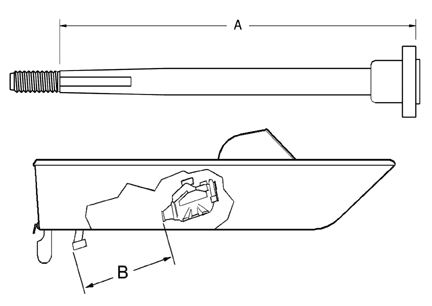
shaft length, please supply us with either dimension A or dimension B.
The diameter of the
shaft, if unknown, is easily determined by measuring with calipers or a
tape measure. (Back To Top)
Engine
Alignment
For inboard boats,
engine alignment is very important. The flanges of the coupling and the
transmission on a properly aligned engine are within .003” of parallel.
Improper alignment causes vibration, and greatly increases wear on the
engine, transmission, strut bearings and the stuffing box. Significant
engine misalignment can also break the drive shaft. To keep your boat
running shipshape, and to prevent damage, check engine alignment any
time there is noticeable vibration and whenever the coupling is
unbolted from the transmission.
Ideally, the engine
should be aligned with the boat in the water, but for most boats
satisfactory results can be obtained while it is on the trailer. Before
checking engine alignment, remove any burrs or dings that may prevent
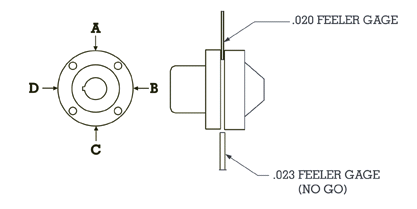
the flanges from mating properly. Then use two feeler gages sized .003”
apart, for example, .020”, and .023” to check engine alignment. Place
the .020” feeler gage between the transmission flange and the coupling
flange at position A and take up any excess gap. Determine if the .023”
feeler gage will or will not go between the flanges at positions B, C,
and D. Repeat this procedure using the .020” feeler gage at positions
B, C, and D. If the .023” feeler gage will not go between the flanges
at any of the locations, the engine is aligned properly. Otherwise the
engine is out of alignment and should be realigned before the boat is
returned to service.(Back To Top)
|